

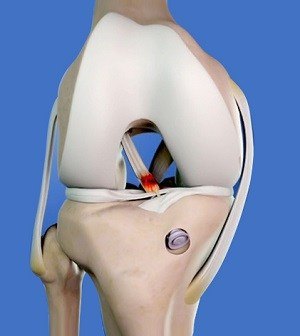
What is Revision ACL Surgery?
Revision anterior cruciate ligament (ACL) surgery is a procedure to correct a failed ACL reconstruction. ACL reconstruction is a surgical procedure to replace the torn ACL with part of a tissue graft (tendon) taken from your leg (autograft) or a donor (allograft).
ACL injuries most often occur during sports activities that involve pivoting, cutting, and turning movements as in football, soccer, skiing, tennis, and basketball. ACL injuries are defined as damage or tear of the anterior crucial ligament.
The anterior cruciate ligament is one of the major stabilizing ligaments in the knee. It is a strong rope-like structure located in the center of the knee, running from the femur (thighbone) to the tibia (shinbone). The ACL is one of the four major ligaments of the knee that connects the femur to the tibia and helps stabilize your knee joint. It prevents excessive forward movement of the tibia in relation to the femur as well as limits rotational movements of the knee. When this ligament tears, unfortunately, it does not heal on its own and often leads to the feeling of instability in the knee, requiring reconstruction to correct the abnormality.
What are the Indications for Revision ACL Surgery?
You may need a revision ACL surgery if the previous ACL reconstruction has failed due to the following conditions:
- The graft was not accepted by your body properly
- The graft was placed at an incorrect point in the bone
- Early return to activity before the graft was accepted by the body
- Failure of the reconstructed ligament to heal properly
- Re-injury or re-rupture of the ACL
- Problems arising from the previous surgery
- Other causes of knee instabilities were not corrected during the original procedure
This failure would result in the return of ACL injury symptoms such as swelling, pain, and knee-buckling or giving way (knee instability), warranting a revision ACL surgery.
What is the Procedure for Revision ACL Surgery?
Revision ACL surgery is usually performed under general anesthesia in a minimally invasive arthroscopic technique. In general, the procedure involves the following steps:
- Your surgeon will make two to three small cuts, about 1/4-inch-long, around your knee.
- An arthroscope is inserted into the knee joint through one of the incisions.
- An arthroscope is a thin tubular instrument with a camera, light, and a magnifying lens attached at the end that is connected to an external monitor and enables your surgeon to view the inside of the knee joint.
- Along with the arthroscope, a sterile solution is pumped into the joint to expand it, enabling your surgeon to have a clear view and space to work inside the joint.
- Miniature surgical instruments are passed through the other incisions, and depending upon the reason of graft failure, your surgeon may perform:
- A bone grafting procedure in which more bone is filled or grafted into the damaged area/bone tunnels/original area where the tendon was attached.
- If the graft tendon has ruptured, your surgeon will perform revision reconstruction by extracting more tendon from your shinbone or thighbone or utilize a donor tendon and place the ends into your femur and tibia to reconstruct the ACL.
- If the cartilage has ruptured, then your surgeon will shave or repair the cartilage to address the issues arising out of it.
- Finally, after proper revision is confirmed, the scope and the instruments are withdrawn, and the incisions are sutured and bandaged.
- A brace is usually fitted for two to six weeks depending upon the severity of your injuries or the nature of the revision performed.
What Does Postoperative Care for Revision ACL Surgery Involve?
In general, postoperative care instructions and recovery after revision ACL surgery will involve the following:
- You will be transferred to the recovery area where your nurse will closely observe you for any allergic or anesthetic reactions and monitor your vital signs as you recover.
- You may notice pain, swelling, and discomfort in the knee area. Pain and anti-inflammatory medications are provided as needed to address these.
- You are advised to keep your leg elevated as much as you can while resting to prevent swelling and pain.
- You will be given assistive devices such as crutches with instructions on restricted weight-bearing for 4 to 6 weeks and a knee brace to be worn for the same period of time.
- You are encouraged to walk with assistance as frequently as possible to prevent blood clots.
- Instructions on surgical site care and bathing will be provided to keep the wound clean and dry.
- Refrain from strenuous activities for the first few months and lifting heavy weights for at least 6 months. A gradual increase in activities is recommended.
- An individualized physical therapy protocol will be designed to help strengthen the knee muscles and optimize knee function.
- You will be able to resume your normal daily activities in a month or two, but with certain activity restrictions. Return to sports and full recovery usually takes around 9 months.
- You may return to your work in about 6 weeks if your job is not too physically demanding. Those with physically demanding jobs will require a longer recovery period.
- A periodic follow-up appointment will be scheduled to monitor your progress.
What are the Risks and Complications of Revision ACL Surgery?
Revision ACL surgery is a relatively safe procedure; however, as with any surgery, some risks and complications may occur, such as the following:
- Infection
- Bleeding
- Pain
- Adverse reactions to anesthesia
- Blood clots or deep vein thrombosis
- Damage to adjacent soft tissue structures
- Decreased range of motion
For more information about our services or to schedule an appointment, call us at / or click here to request an appointment online. We’ll respond to you as soon as possible.